Choosing the best Lithium Golf Cart Battery requires more than comparing price tags or advertised amp-hours. Battery chemistry, voltage, usable capacity, charging protection, warranty terms, and installation quality all affect daily performance. The U.S. Department of Energy explains that lithium-ion batteries generally provide higher energy density than lead-acid alternatives. That means less weight for similar energy, which can improve hill climbing, acceleration, and available storage space.
Real-world selection still needs careful judgment. BloombergNEF’s 2024 Battery Price Survey reported a global lithium-ion pack price of about $115 per kilowatt-hour, showing how rapidly battery technology and manufacturing costs are changing. However, lower prices do not automatically indicate better value. A golf cart used on steep private roads needs different performance from one used for short, flat resort trips. Range matters. So does charging time.
Look beyond the label.
A reliable Lithium Golf Cart Battery should match the cart’s original voltage system and motor requirements. Its battery management system should protect against overcharging, overheating, excessive discharge, and cell imbalance. UL 2271 certification, where applicable, can provide an additional safety reference for light electric vehicle batteries. The International Energy Agency also highlights the growing importance of battery durability, supply chains, and responsible manufacturing across the energy sector.
Some claims remain difficult to verify. “Thousands of cycles” may depend on temperature, discharge depth, and maintenance. A longer warranty may hide strict operating conditions. Therefore, the best choice is not always the most powerful battery. It is the safest, properly sized, and supportable option for your cart, terrain, budget, and charging routine.
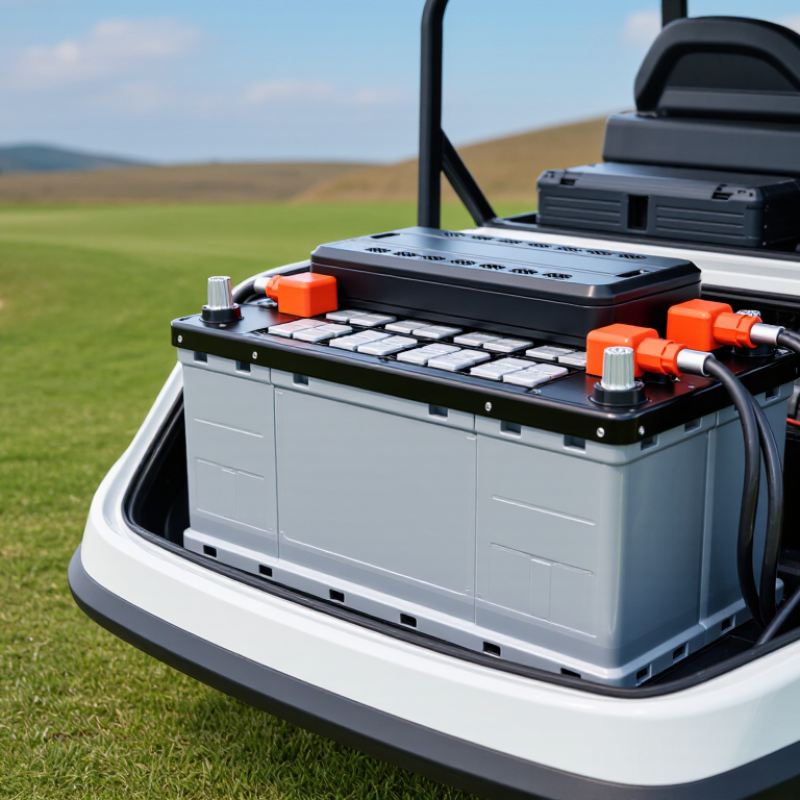
Define Cart Voltage and Capacity: 36V, 48V, or 72V; 100–300Ah
How to Choose the Best Lithium Golf Cart Battery?
Start with the cart’s voltage. A 36V system usually suits older, lighter carts. A 48V system offers a practical balance between climbing ability, speed, and energy use. A 72V setup can deliver stronger acceleration, but it demands a compatible controller, charger, cables, and motor. Never install a higher-voltage battery by guessing. Check the motor label and service manual first.
Capacity matters just as much. Battery energy is calculated as voltage multiplied by amp-hours. Therefore, a 48V 100Ah battery stores about 4.8kWh, while a 48V 300Ah battery stores about 14.4kWh. The larger pack may support longer routes, heavy loads, hills, and frequent stops. Real results remain lower than the calculation. Temperature, tire pressure, passenger weight, and driving style all reduce usable range. I have seen range estimates fail on steep courses.
Industry data provides useful context, but not a perfect answer. BloombergNEF’s 2024 Lithium-Ion Battery Price Survey reported an average pack price of 115 dollars per kWh, a 20% annual decline. This figure mainly covers broader vehicle batteries, not complete golf-cart installations. The International Energy Agency’s Global EV Outlook 2024 also reported a 14% fall in lithium-ion pack prices during 2023. Treat these figures as market benchmarks. For most carts, matching voltage correctly matters more than buying the largest Ah rating. A 48V 150–200Ah battery is often a sensible starting range, but actual course distance should decide the final capacity.
How to Choose the Best Lithium Golf Cart Battery? - Define Cart Voltage and Capacity: 36V, 48V, or 72V; 100–300Ah
| Cart Voltage Class |
Typical LiFePO₄ Pack Rating |
Capacity |
Nominal Energy |
Approx. Usable Energy
(90% Depth of Discharge) |
Approx. Runtime at a 1 kW Average Load |
Recommended Application |
Typical Full-Charge Voltage |
Selection Considerations |
| 36V |
38.4V |
100Ah |
3.84 kWh |
3.46 kWh |
About 3.5 hours |
Light-duty carts, short trips, flat terrain, and basic utility use |
43.8V |
Confirm that the cart controller and charger support a 12-series LiFePO₄ battery. |
| 36V |
38.4V |
150Ah |
5.76 kWh |
5.18 kWh |
About 5.2 hours |
Regular recreational use and moderate daily driving |
43.8V |
Provides more operating time without changing the cart voltage class. |
| 36V |
38.4V |
200Ah |
7.68 kWh |
6.91 kWh |
About 6.9 hours |
Longer recreational routes, heavier loads, and frequent daily use |
43.8V |
Check battery compartment dimensions and vehicle weight limits before installation. |
| 36V |
38.4V |
300Ah |
11.52 kWh |
10.37 kWh |
About 10.4 hours |
Extended-duty utility applications requiring maximum 36V energy storage |
43.8V |
Large capacity may require reinforced mounting, adequate ventilation, and sufficient charging time. |
| 48V |
51.2V |
100Ah |
5.12 kWh |
4.61 kWh |
About 4.6 hours |
Common choice for modern golf carts, mixed terrain, and general-purpose use |
58.4V |
Often offers a practical balance between performance, efficiency, and battery size. |
| 48V |
51.2V |
150Ah |
7.68 kWh |
6.91 kWh |
About 6.9 hours |
Frequent recreational driving, moderate hills, and passenger transport |
58.4V |
Verify that the battery management system can handle the controller’s peak current. |
| 48V |
51.2V |
200Ah |
10.24 kWh |
9.22 kWh |
About 9.2 hours |
Long-range use, hilly courses, heavier loads, and commercial operations |
58.4V |
High capacity increases range, but the battery enclosure must have enough physical space. |
| 48V |
51.2V |
300Ah |
15.36 kWh |
13.82 kWh |
About 13.8 hours |
Heavy-duty utility carts and extended commercial operating cycles |
58.4V |
Use only when the cart, wiring, charger, mounting system, and suspension are appropriately rated. |
| 72V |
76.8V |
100Ah |
7.68 kWh |
6.91 kWh |
About 6.9 hours |
High-performance carts, steep terrain, and applications needing higher system power |
87.6V |
Usually requires a dedicated 72V drivetrain, controller, charger, and safety-rated wiring. |
| 72V |
76.8V |
150Ah |
11.52 kWh |
10.37 kWh |
About 10.4 hours |
Long-distance high-speed use, steep grades, and demanding utility work |
87.6V |
Confirm compatibility with the motor, controller, charger, DC-DC converter, and accessories. |
| 72V |
76.8V |
200Ah |
15.36 kWh |
13.82 kWh |
About 13.8 hours |
Extended high-power operation with substantial payload requirements |
87.6V |
Higher voltage can deliver strong performance, but installation and protection requirements are more demanding. |
| 72V |
76.8V |
300Ah |
23.04 kWh |
20.74 kWh |
About 20.7 hours |
Maximum-duration commercial, industrial, and heavy-duty applications |
87.6V |
Requires careful engineering of battery weight, structural mounting, charging, cabling, and thermal management. |
Important: The voltage class must match the golf cart’s motor, controller, charger, wiring, and accessories. A 72V battery should not be installed in a 36V or 48V cart without a complete, professionally engineered system conversion.
Energy calculation: Nominal energy is calculated as pack voltage × amp-hours. Actual driving range varies with speed, terrain, payload, tire pressure, temperature, motor efficiency, and driving habits.
Capacity selection: Higher Ah generally provides longer operating time, but it can increase battery size, weight, cost, and charging time. The battery management system’s continuous and peak current ratings must also meet the cart controller’s requirements.
Battery chemistry basis: Pack values shown are typical LiFePO₄ configurations: 12-series for the 36V class, 16-series for the 48V class, and 24-series for the 72V class.
Compare Lithium Chemistry: LiFePO₄ Offers 2,000–5,000 Cycles at 80% DoD
How to Choose the Best Lithium Golf Cart Battery?
LiFePO₄ chemistry offers a useful balance between safety, weight, and service life. Under controlled conditions, it commonly delivers 2,000–5,000 cycles at 80% depth of discharge. A 2023 review in the Journal of Energy Storage links this durability to lithium iron phosphate’s stable crystal structure and stronger thermal resistance. The number is not a promise. Heat, charging voltage, storage level, and heavy acceleration can reduce it.
Consider a 48-volt, 100Ah battery. Its nominal capacity is about 4.8 kWh, with roughly 3.84 kWh available at 80% discharge. Controller losses, wiring resistance, hills, tire pressure, and passenger weight reduce practical range. I would test the cart on its usual route, not only trust laboratory figures. A battery lasting eight years sounds impressive, but poor charging habits may shorten that result.
The International Energy Agency’s Global EV Outlook 2024 reports that LFP batteries represented nearly 40% of the global electric-car battery market in 2023, reflecting wider industry confidence in this chemistry. For product evaluation, IEC 62620 provides recognized performance-testing principles for rechargeable lithium cells. Ask for cycle-test conditions, usable capacity, low-temperature limits, and battery-management protections. Some specifications hide these details. That deserves skepticism. A reliable choice should match the cart’s voltage, motor demand, charger profile, and daily distance, rather than simply advertise the highest cycle count.
Match Battery Size to Range: Use 48V × Ah to Estimate Stored Energy
How to Choose the Best Lithium Golf Cart Battery?
Match Battery Size to Range: Use 48V × Ah to Estimate Stored Energy
Battery voltage and amp-hours reveal stored energy more clearly than amp-hours alone. Multiply 48 volts by 100Ah, and the battery stores 4,800Wh, or 4.8kWh, nominally. That figure is not your driving range. Motor load, hills, tire pressure, passenger weight, and temperature reduce usable energy. The U.S. Department of Energy’s Energy Storage Grand Challenge Roadmap explains that rated capacity differs from usable capacity because operating limits and losses matter.
A practical estimate starts with energy consumption. If your cart uses about 120Wh per mile, a 48V 100Ah battery could theoretically provide 40 miles before losses. Allowing 15% efficiency loss gives roughly 34 miles. NREL’s 2024 Annual Technology Baseline uses approximately 85% round-trip efficiency for representative lithium-ion storage systems. A golf cart is not a stationary battery, but that assumption offers a cautious reference point. Real-world results will vary.
Do not buy by voltage alone. A 48V 60Ah pack stores 2.88kWh, while a 48V 150Ah pack stores 7.2kWh. The larger pack may deliver longer range, but it can add weight and charging time. Check the battery’s continuous discharge rating, temperature limits, warranty conditions, and compatible charger. I would also measure one familiar route with a watt-hour meter. Estimates are imperfect. Your weekly route may expose that quickly.
Verify Safety and Compliance: UL 2271, IEC 62619, and UN 38.3
When choosing a lithium golf cart battery, safety documents deserve as much attention as capacity and range. UL 2271 evaluates rechargeable battery packs used in light electric vehicles, including protection against fire, shock, and abnormal operation. Ask for a certificate that matches the exact battery model, not merely a similar product family.
IEC 62619 addresses the safety of industrial lithium batteries. It examines controls such as overcharge protection, short-circuit response, thermal safety, and cell management. A dependable supplier should provide test reports, ratings, and clear installation instructions. Check whether the battery management system matches the pack voltage and charging method. Small mismatches can create serious heat.
UN 38.3 confirms that the battery has passed required transport tests, including vibration, impact, altitude, and temperature cycling. It supports safer shipping, but it is not a complete product safety certification. A shipping test alone proves too little. Inspect labels, production dates, fuse details, and emergency guidance before purchasing. I have found that paperwork often looks convincing until model numbers are compared carefully. That step is easy to skip. Do not.
Installation quality also matters. Loose terminals, undersized cables, or an unsuitable charger can undermine tested protection. Ask who performed the testing and whether documents can be independently verified. Standards reduce risk, but they cannot replace careful inspection and realistic maintenance planning.
How to Choose the Best Lithium Golf Cart Battery?
Verify the battery’s safety and compliance scope before purchase.
This scope matrix shows the primary purpose of each standard. UL 2271 focuses on battery safety for light electric vehicle and related applications, IEC 62619 addresses the safety of industrial lithium secondary cells and batteries, and UN 38.3 covers transport testing for lithium cells and batteries. A value of 1 indicates that the topic is directly addressed; 0 indicates that it is not the standard’s primary purpose. These indicators are not pass/fail results.
Evaluate BMS, Charging, Warranty, and Total Cost per Cycle
How to Choose the Best Lithium Golf Cart Battery?
Evaluate BMS, Charging, Warranty, and Total Cost per Cycle
A reliable lithium golf cart battery starts with its battery management system, or BMS. During testing, check whether it protects against overcharging, deep discharge, short circuits, and excessive temperature. A useful BMS should balance individual cells and provide clear fault information. Without this protection, performance may become unpredictable. Ask whether the system records faults or simply shuts down without explanation.
Charging details matter just as much. Confirm that the charger matches the battery’s voltage, chemistry, and recommended charging profile. Look for temperature-based charging protection, especially if the cart operates in cold mornings or hot storage areas. A charger that stops near full charge can reduce stress on the cells. Do not assume the original charger is compatible. That mistake can be expensive.
Warranty language deserves careful reading. Check the covered cycle count, calendar period, capacity-retention promise, labor coverage, and shipping responsibility. “Eight-year warranty” sounds strong, but the practical value depends on exclusions and claim procedures. Calculate total cost per cycle: battery price, charger cost, installation, and likely replacement expenses divided by expected usable cycles. A lower purchase price may produce a higher cycle cost. Real usage is messier than laboratory ratings; hills, heavy loads, poor storage, and incomplete charging can shorten battery life. Track your driving distance and charging habits for a more honest estimate.
FAQS
Safety documents help confirm protection against fire, shock, overheating, and abnormal operation. Ask for documents matching the exact battery model. Similar model numbers are not enough.
UL 2271 evaluates rechargeable battery packs for light electric vehicles. It examines fire resistance, electric shock protection, and abnormal operating conditions. Check the certificate carefully.
IEC 62619 focuses on industrial lithium battery safety. It examines overcharge protection, short-circuit response, thermal controls, and cell management. Ask for test reports and installation instructions.
UN 38.3 covers transport tests, including vibration, impact, altitude, and temperature cycling. It supports safer shipping. It does not prove complete product safety.
Compare the model number, production date, ratings, fuse details, and test information. Ask whether documents can be independently verified. Paperwork can look convincing.
Check terminal tightness, cable size, charger compatibility, labels, and emergency guidance. Loose terminals can create heat. Small installation mistakes matter.
A BMS should protect against overcharging, deep discharge, short circuits, and excessive temperature. It should balance cells and show clear fault information. Silent shutdowns are frustrating.
Match the charger with the battery’s voltage, chemistry, and charging profile. Temperature-based protection is useful during cold mornings and hot storage. Never assume the old charger fits.
Review cycle limits, warranty duration, capacity retention, labor coverage, exclusions, and shipping responsibility. Include the charger and installation costs. A cheaper battery may cost more per cycle.
Track driving distance, charging habits, storage temperature, hills, and carried loads. Laboratory ratings are only estimates. My calculation may still be imperfect, but real records help.
Conclusion
Choosing the best Lithium Golf Cart Battery starts with identifying your cart’s voltage requirement, such as 36V, 48V, or 72V, and selecting a suitable capacity between 100Ah and 300Ah. LiFePO₄ chemistry is often preferred for its dependable performance and potential service life of approximately 2,000–5,000 cycles at 80% depth of discharge. To estimate stored energy and expected range, multiply the battery voltage by its amp-hour rating, while also considering terrain, load, driving habits, and weather conditions.
A reliable battery should include a properly matched battery management system, an appropriate charger, and clearly stated safety certifications or testing, such as UL 2271, IEC 62619, and UN 38.3. Buyers should also review installation requirements, warranty coverage, charging performance, and long-term maintenance needs. Instead of judging price alone, compare the total cost per cycle to understand the battery’s overall value and determine whether it can deliver safe, consistent, and economical service.