A 6-Passenger Electric Golf Cart is more than a stretched two-seat cart. It is a compact, battery-powered people mover designed for golf courses, resorts, campuses, communities, and large private properties. Its rear-facing seats can carry six occupants, while a quiet electric drivetrain reduces noise near homes, greens, and pedestrian paths. The vehicle usually includes a 48-volt system, regenerative braking, LED lighting, seat belts, and onboard charging.
Market evidence supports this wider role. The National Golf Foundation reported approximately 531 million rounds played in the United States during 2023, sustaining demand for dependable course transportation. Meanwhile, Grand View Research estimated the global golf cart market at about USD 1.89 billion in 2023, with continued growth expected through 2030. These figures describe the broader market, not only six-passenger models. That distinction matters.
As Tom McDonald, president of Yamaha Golf-Car Company, has said, “Electric mobility works best when it matches the route, load, and charging routine.” The practical meaning is clear. A six-passenger cart needs more than a larger bench. It needs stable handling, sufficient battery capacity, reliable hill performance, and predictable charging time. Six adults, bags, and a steep path can expose weak specifications quickly.
Real-world fit comes first. A cart that travels smoothly on flat fairways may struggle on wet slopes or crowded resort roads. Range claims can also feel optimistic. Battery age, tire pressure, passenger weight, temperature, and terrain change daily performance. Therefore, this guide examines what a 6-Passenger Electric Golf Cart is, how it works, and where its compromises deserve careful attention. It is useful mobility. Not a miniature car.
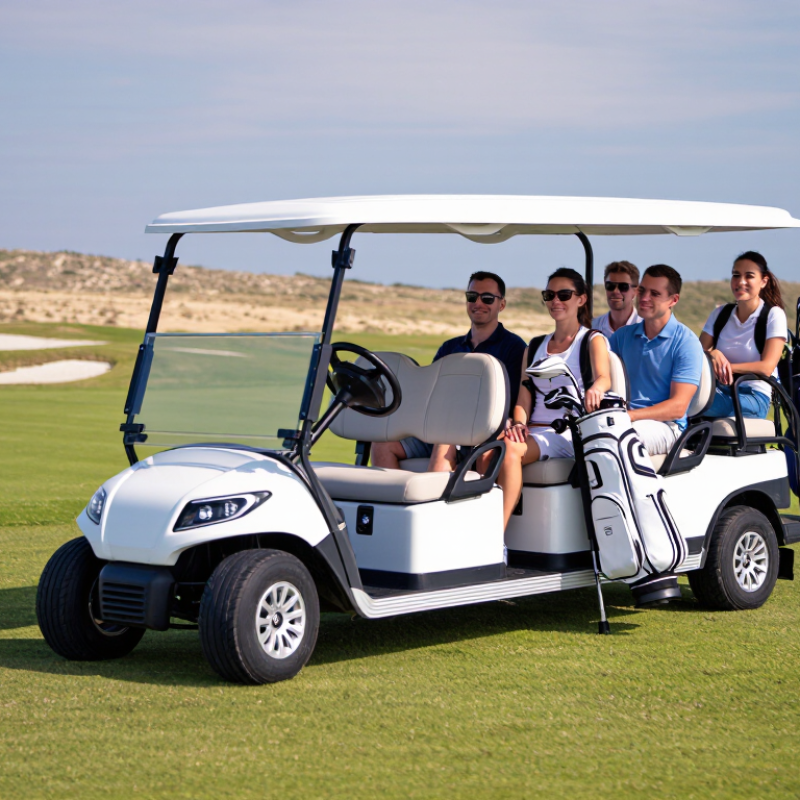
A 6-passenger electric golf cart is a low-speed vehicle designed to carry six people using battery power.
It usually has two bench seats, with four passengers facing forward and two facing backward. Some layouts place all riders forward, but this can increase the vehicle’s length.
The electric motor produces little noise and no exhaust during operation.
Its core components include a rechargeable battery, onboard charger, controller, suspension, steering system, and mechanical or hydraulic brakes. In practical use, a full passenger load makes acceleration slower. That is normal.
The cart’s real performance depends on payload capacity, battery condition, terrain, and maintenance.
A dependable model should provide clear information about seating capacity, maximum load, ground clearance, turning radius, lighting, mirrors, and seat belts.
Range estimates can be optimistic. I would not treat them as guarantees, especially on hills or rough paths. Charging time, battery age, and temperature also affect daily performance. Local operating requirements should be checked before using the cart on public roads or shared paths.
Tips:
Check tire pressure before carrying six passengers. Inspect the brakes often. Keep heavy items low and centered. Charge the battery in a dry, ventilated area. Test the cart on a quiet surface first. A short test reveals more than a brochure. Do not overload the rear storage area, even when the cart still feels stable.
A 6-passenger electric golf cart usually carries two seating rows, often with three passengers per row. Some models use forward-facing seats, while others place the rear passengers back-to-back. This difference affects legroom, visibility, and boarding.
A six-person rating does not always mean six adults will ride comfortably. Battery weight, passenger size, cargo, and terrain can change handling. The Society of Automotive Engineers recommends considering total vehicle mass, not seating count alone.
Passenger capacity also depends on the cart’s rated payload. The ANSI/ITSDF B56.8 standard addresses design and safety requirements for personnel and utility transport vehicles. Buyers should check the manufacturer’s load rating, braking performance, and slope limits.
A crowded cart may need more stopping distance. That detail is easy to miss.
Seat belts, stable handholds, mirrors, headlights, brake lights, and turn signals improve control around pedestrians and traffic. The U.S. Consumer Product Safety Commission has reported roughly 15,000 golf-cart-related injuries annually in the United States, based on emergency department estimates.
Falls and rollovers remain important concerns, especially when passengers stand or sit on unprotected edges. The National Highway Traffic Safety Administration also distinguishes low-speed vehicles from ordinary golf carts, showing why road use requires careful classification.
In practice, drivers should reduce speed on wet grass, sharp turns, and uneven paths. Even experienced operators make mistakes. A six-passenger cart needs disciplined loading, calm acceleration, and regular brake and tire inspections.
A six-passenger electric golf cart uses a battery pack, motor controller, and electric motor. The controller regulates torque from the accelerator pedal. Many utility-style carts use a 48-volt system, although voltage varies by design. Extra seats increase weight, especially with six adults and equipment onboard. Hills, soft ground, and frequent stops can reduce range sharply.
Lead-acid batteries remain common because they cost less initially. Flooded batteries require water checks, clean terminals, and careful ventilation during charging. Absorbed glass mat batteries reduce maintenance but still carry substantial weight. Lithium-ion batteries usually provide higher usable capacity and faster charging. Lithium iron phosphate chemistry is often selected for its thermal stability. BloombergNEF’s 2024 Battery Price Survey reported an average lithium-ion pack price of 115 dollars per kilowatt-hour. That figure does not equal a finished cart price, but it explains why larger packs remain expensive.
A mismatched charger can shorten battery life or create serious overheating risks. The U.S. Department of Energy’s Alternative Fuels Data Center defines Level 2 charging as 208–240 volts, with equipment commonly delivering 2.5–19.2 kilowatts. Most golf carts use smaller dedicated chargers, so household charging may take several hours. Check the manual, inspect the connector, and keep ventilation clear. Range estimates are imperfect. A practical test with real passengers is more trustworthy than a brochure.
What Is a 6-Passenger Electric Golf Cart?
Performance, Range, and Terrain Capabilities
A 6-passenger electric golf cart uses a larger frame, longer wheelbase, and higher battery demand than a two-seat model. Typical systems operate at 48 or 72 volts, with motors commonly rated between 5 and 15 kW. Real-world speed often reaches 15–25 mph, depending on load, controller settings, and local requirements. The U.S. Department of Energy notes that low-speed electric vehicles lose efficiency when weight, hills, and repeated acceleration increase. That matters here. Six adults, groceries, and a steep path can change the driving feel quickly.
Range claims require caution. Many carts advertise 30–50 miles per charge, but those figures usually assume level pavement, moderate temperatures, and a lightly loaded vehicle. The National Renewable Energy Laboratory identifies temperature, payload, and driving conditions as major influences on battery performance. Lead-acid batteries also need regular charging discipline and may deliver less usable energy as they age. Lithium batteries usually maintain voltage better, though their higher purchase cost deserves attention. A small mistake is assuming the biggest battery always gives the best range.
Terrain capability depends on ground clearance, tire design, suspension travel, and torque delivery. On firm grass or compact gravel, four-wheel suspension and all-terrain tires improve stability. Wet slopes are different. Loose soil can overwhelm traction before the motor reaches its rated power. SAE J1634 provides standardized procedures for electric-vehicle energy testing, but many golf carts are not tested under that cycle. Therefore, compare independent measurements, not only dashboard estimates. Test the cart with realistic passengers, because an empty-cart trial can be misleading.
| Data Dimension | Typical Specification | Performance Description | Terrain Capability |
|---|---|---|---|
| Passenger Capacity | 6 occupants | Usually arranged as two forward-facing seats and a rear-facing bench seat. | Suitable for private communities, resorts, campuses, and low-speed paved roads where permitted. |
| Motor Output | Approximately 4–15 kW | Power varies by motor design, controller settings, vehicle weight, and whether the cart uses two- or four-wheel drive. | Higher-output systems provide better hill climbing and acceleration with six occupants. |
| Top Speed | Typically 19–25 mph (31–40 km/h) | Many vehicles are electronically limited for stability, safety, and compliance with low-speed-vehicle regulations. | Best suited to controlled, low-speed environments rather than highways or high-speed roads. |
| Driving Range | Approximately 25–60 miles (40–97 km) per charge | Actual range depends on battery type, passenger load, speed, temperature, tire pressure, and terrain. | Flat pavement delivers the most consistent range; steep hills, soft ground, and frequent stops reduce it. |
| Battery Options | Lead-acid or lithium-ion; commonly 48–72 V | Lithium-ion batteries are generally lighter and require less routine maintenance, while lead-acid systems may have a lower initial cost. | A lighter battery pack can improve handling and reduce ground pressure on grass or compact trails. |
| Charging Time | About 6–10 hours with a standard onboard charger | Charging time depends on battery capacity, charger output, state of charge, and battery temperature. | Overnight charging is practical for regular daily operation; adequate ventilation and a suitable electrical outlet are required. |
| Rated Payload | Approximately 1,000–1,400 lb (454–635 kg) | The payload normally includes passengers, luggage, accessories, and any cargo carried on the vehicle. | Staying within the rated payload helps preserve braking, steering, acceleration, and hill-climbing performance. |
| Climbing Ability | Approximately 15–25% grade under typical load | A 15% grade rises about 15 feet for every 100 feet of horizontal distance. Performance decreases as load and slope increase. | Suitable for moderate paved or compacted inclines; wet grass and loose gravel can reduce traction significantly. |
| Ground Clearance | Approximately 4–7 inches (10–18 cm) | Clearance is influenced by tire size, suspension design, battery placement, and passenger load. | Adequate for lawns, paved paths, and maintained gravel; not intended for deep ruts, large rocks, or severe mud. |
| Drive Configuration | Rear-wheel drive is common; four-wheel drive is available on some models | Rear-wheel drive is efficient for normal paths, while four-wheel drive can improve low-speed traction. | Four-wheel drive is more capable on wet grass, loose gravel, moderate slopes, and uneven ground, but it does not make the cart an extreme off-road vehicle. |
| Braking System | Mechanical or hydraulic service brakes; regenerative braking may be included | Braking distance increases with speed, passenger load, downhill travel, and slippery surfaces. | Use reduced speed on descents and uneven surfaces; regenerative braking does not replace the service brake. |
| Turning Radius | Approximately 10–16 feet (3.0–4.9 m) | The longer wheelbase of a six-passenger cart generally requires more maneuvering space than a two-passenger cart. | Works well on roads, paths, and parking areas, but may need extra space on narrow wooded or landscaped trails. |
| Recommended Operating Environment | Low-speed, private, and properly approved public-use areas | A six-passenger electric golf cart combines quiet operation, low local emissions, and seating for group transportation. | Confirm local rules before using the vehicle on public roads, and avoid flooding, deep mud, extreme slopes, and terrain beyond the owner's manual limits. |
Note: Specifications are representative ranges for six-passenger electric golf carts. Exact performance varies by vehicle configuration, battery condition, ambient temperature, load, maintenance, and surface conditions.
What Is a 6-Passenger Electric Golf Cart?
A 6-passenger electric golf cart is a compact vehicle with two facing benches. It uses rechargeable batteries and usually travels at modest speeds. Families use it in gated communities, resorts, farms, campuses, and large private properties. It can carry people, groceries, sports equipment, or light tools. The rear-facing seats improve capacity but require careful loading. Passengers should remain seated, especially on slopes or uneven paths.
Legal requirements depend on the country, state, province, and road classification. A cart used only on private property may follow simpler rules. Public-road operation may require registration, insurance, working lights, reflectors, mirrors, seat belts, and a slow-vehicle emblem. Some areas also require a valid driver’s license, minimum age, or equipment inspections. Speed limits can differ between ordinary roads and designated low-speed routes. Never assume that a cart legal on one street is legal everywhere. Local transport authorities provide the most reliable guidance.
Maintenance needs are manageable, but neglect becomes expensive. Check tire pressure, brake response, steering play, lights, and battery connections regularly. Lead-acid batteries need correct water levels and ventilation during charging. Lithium batteries still need approved chargers and protection from extreme heat. Keep charging cables dry and inspect them for cuts. Wash off mud, then dry the underbody to reduce corrosion. A practical mistake is carrying six adults without checking payload limits. That habit strains brakes, suspension, and battery range. Small checks matter.
It is a battery-powered, low-speed vehicle for six riders. It usually has two bench seats. Some rear passengers face backward.
Not always. Seat design, body size, cargo, and legroom affect comfort. A six-person rating does not guarantee spacious seating. Measure carefully.
Acceleration becomes slower, especially on hills or rough paths. Stopping may also require more distance. That is normal.
Check the payload rating, ground clearance, turning radius, and seat arrangement. Also inspect lighting, mirrors, seat belts, and braking performance. Numbers can mislead.
Range depends on battery age, passenger weight, terrain, temperature, and tire pressure. Hills and rough surfaces reduce range. Published estimates are not guarantees.
Seat belts, handholds, mirrors, headlights, brake lights, and turn signals improve control. Passengers should remain seated during movement. Standing is unsafe.
Keep people seated evenly across both benches. Place heavy items low and near the center. Do not overload the rear storage area.
Check tire pressure before carrying six passengers. Inspect the brakes regularly. Charge in a dry, ventilated area. Test it quietly.
Check local operating requirements before using it there. The vehicle may need specific equipment or approval. Rules differ by location.
A 6-Passenger Electric Golf Cart is a battery-powered vehicle designed to transport up to six people comfortably at low speeds. It typically features two rows of seating, step-in access, handrails, seat belts, lights, mirrors, and other safety equipment. The rear seats may include folding or reinforced designs to improve flexibility, but passengers should remain within the stated capacity and use proper restraints whenever provided.
Its electric powertrain generally includes a motor, controller, rechargeable battery pack, and onboard charger. Depending on the battery type and vehicle setup, charging may require several hours using a suitable electrical connection. Driving range, speed, and terrain performance can vary with passenger weight, hills, road conditions, weather, and battery condition. These carts are commonly used on private properties, resorts, campuses, communities, and event grounds. Before operating one in public areas, owners should check local requirements for registration, permitted roads, equipment, age limits, and insurance. Regular inspections, battery care, tire checks, brake testing, cleaning, and scheduled servicing help maintain safe and reliable operation.